American students : “There might never be a better time for Azerbaijan to strike a peace deal”
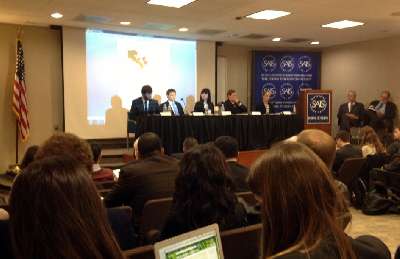 A group of American students who recently returned from a Karabakh field trip, urges Azerbaijani and Armenian governments to “start immediately de-radicalizing their people”, to reach a final peace.
“The time serves for no one : Instead of looking back and seeing what happened, it is important for Armenia and Azerbaijan to look forward and see what can happen.” Sixteen students of Johns Hopkins University’s School of Advanced International Studies said this after they spent ten days in Baku, Yerevan and Khankendi earlier this year. They interviewed leaders and members of international organizations in the region of conflict.
The objective of the trip was to gain a deeper understanding of the roots of the conflict; to evaluate the conflict management efforts that have taken place; and finally to present recommendations about how best to advance the process of long-term conflict resolution and peace building.
The students presented their report and discussed their findings in front of DC-based analysts, scholars and diplomats on Tuesday, April 2, TURAN’s Washington correspondent reports.
Speaking about the internal situation in the conflict, the group mentioned the “need of de-radicalizing of people on both sides.”
Both Azerbaijani and Armenian governments should start working “to foster understanding, and to have religious diplomacy take place”, the lack of contact of both nations, makes “Track 2 diplomacy difficult with the media perpetuating misunderstanding”.
The politicians in both countries, however, share “common interests” – radicalizing civil society.
“Attitudes and perceptions must change to build trust between all parties in the conflict,” said Jamie Pleydell-Bouverie, SAIS Post-graduate student and a member of the Karabakh field trip.
“There might never be a better time for Azerbaijan to strike a peace deal,” he added.
Speaking on the international peacemaking situation, Kaelyn Lowmaster, another student, emphasized that the EU must bolster OSCE efforts and the Minsk Group must reevaluate its chairs in the conflict.
Germany, she added, might be “a great candidate” to replace France in the MG, to give more balance and possibly less diaspora influence to the group.
The core challenge of the conflict, according to the students, is “territorial integrity vs. self-determination”.
Speaking about the displaced people and humanitarian issues between Armenia and Azerbaijan, the students mentioned that Armenian isolation provides a way for Russian influence in its economy that is in conflict with Azerbaijan.
In the meantime, as a regional actor, Russia, same as Iran and Turkey, “is not helping the peace”.
“Russia, Iran and Turkey are biased interlocutors due to interests in the Caucasus,” added another student, Ivan Benovic.
Armenia, he said, “must give up all claims against Turkey allaying irredentist claims and the fears of pan-Turkism for the respective sides”.
In his comment, Armenian Embassy representative dismissed any connection between the Karabakh conflict and his country’s historic problem with Turkey.
Even though the debate was open to the public, neither the Azeri ambassador, nor other top Azeri diplomats attended.
Earlier that day, several top Azeri diplomats participated in a Woodrow Wilson Center event on “connecting the Caucasus with the world through railways and pipelines”, seeking the answer to the questions such as “what lessons can we draw from the Baku-Tbilisi-Ceyhan pipeline,” etc.
http://www.contact.az/docs/2013/Politics/040300033329en.htm
News from http://www.contact.az
 AZERI AMERICA
http://www.amerikaninsesi.org/content/amerika-cons-hopkins/1634311.html
Vaşinqtonun Cons Hopkins Universitetində “Dağlıq Qarabağ-Münaqişəsini Anlamaq” başlıqlı konfrans keçirildi
Американские студенты: Баку и Еревану нужна дерадикализация- http://www.contact.az/docs/2013/Politics/040300033330ru.htm